

1891-92 English Division One
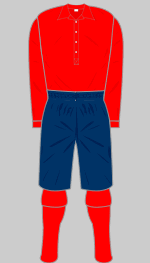
Fixtures
| Date | Opponents | Score | |||
|---|---|---|---|---|---|
| Sep | 5 | H | Burnley | W | 1 - 0 |
| 12 | A | Derby | L | 3 - 1 | |
| 14 | A | Wolves | L | 5 - 0 | |
| 19 | A | Darwen | L | 5 - 2 | |
| 26 | H | Everton | D | 1 - 1 | |
| Oct | 3 | A | Bolton | W | 3 - 4 |
| 10 | H | Darwen | D | 1 - 1 | |
| 24 | H | Wolves | W | 3 - 2 | |
| 31 | A | Sunderland | L | 4 - 1 | |
| Nov | 7 | H | Bolton | L | 0 - 3 |
| 14 | A | Burnley | L | 2 - 1 | |
| 21 | H | Notts Co | W | 2 - 0 | |
| 28 | A | Notts Co | L | 9 - 0 | |
| Dec | 5 | A | West Brom | L | 3 - 1 |
| 19 | A | Stoke | L | 3 - 1 | |
| 26 | A | Blackburn | D | 2 - 2 | |
| Jan | 2 | H | Preston | L | 1 - 3 |
| 4 | H | Aston Villa | W | 3 - 2 | |
| 9 | H | Stoke | W | 3 - 0 | |
| 16 | A | Crusaders Belf | W | 1 - 4 | |
| 23 | H | West Brom | W | 4 - 2 | |
| Feb | 6 | H | Sunderland | L | 1 - 3 |
| 27 | H | Blackburn | W | 1 - 0 | |
| Mar | 5 | H | Sunderland | L | 3 - 5 |
| 12 | A | Aston Villa | L | 12 - 2 | |
| 19 | A | Everton | L | 3 - 0 | |
| Apr | 2 | H | Derby | D | 1 - 1 |
| 15 | A | Preston | L | 4 - 1 |
Final League Table 1891-92
| H | A | |||||||||||||
|---|---|---|---|---|---|---|---|---|---|---|---|---|---|---|
| P | W | D | L | F | A | W | D | L | F | A | GD | PTS | ||
| 1 | Sunderland | 26 | 13 | 0 | 0 | 55 | 11 | 8 | 0 | 5 | 38 | 25 | +57 | 42 (C) |
| 2 | Preston | 26 | 12 | 0 | 1 | 42 | 8 | 6 | 1 | 6 | 19 | 23 | +30 | 37 |
| 3 | Bolton | 26 | 9 | 2 | 2 | 29 | 14 | 8 | 0 | 5 | 22 | 23 | +14 | 36 |
| 4 | Aston Villa | 26 | 10 | 0 | 3 | 63 | 23 | 5 | 0 | 8 | 26 | 33 | +33 | 30 |
| 5 | Everton | 26 | 8 | 2 | 3 | 32 | 22 | 4 | 2 | 7 | 17 | 27 | 0 | 28 |
| 6 | Wolves | 26 | 8 | 2 | 3 | 34 | 15 | 3 | 2 | 8 | 25 | 31 | +13 | 26 |
| 7 | Notts Co | 26 | 9 | 3 | 1 | 41 | 12 | 2 | 1 | 10 | 14 | 39 | +4 | 26 |
| 8 | Burnley | 26 | 9 | 1 | 3 | 34 | 14 | 2 | 3 | 8 | 15 | 31 | +4 | 26 |
| 9 | Blackburn | 26 | 8 | 3 | 2 | 39 | 26 | 2 | 3 | 8 | 19 | 39 | -7 | 26 |
| 10 | Derby | 26 | 6 | 3 | 4 | 28 | 18 | 4 | 1 | 8 | 18 | 34 | -6 | 24 |
| 11 | Accrington | 26 | 7 | 3 | 3 | 24 | 20 | 1 | 1 | 11 | 16 | 58 | -38 | 20 |
| 12 | West Brom | 26 | 6 | 3 | 4 | 37 | 24 | 0 | 3 | 10 | 14 | 34 | -7 | 18 |
| 13 | Stoke | 26 | 5 | 0 | 8 | 19 | 19 | 0 | 4 | 9 | 19 | 42 | -23 | 14 |
| 14 | Darwen | 26 | 4 | 1 | 8 | 31 | 43 | 0 | 2 | 11 | 7 | 69 | -74 | 11 |
Accrington & Stoke re-elected
West Brom no-relection required after winning FA Cup
Darwen league two after not being re-elected
1891–92: A Season of Stagnation
The 1891–92 season marked Accrington’s fourth year in the Football League and a continuation of the steady decline that had begun after their mid-table finishes in the League’s early years. Although the club avoided relegation, the campaign underlined their growing struggle to keep pace with the shifting landscape of English football.
A Faltering Start
From the outset, Accrington found wins hard to come by. Early-season fixtures included heavy defeats to more established sides, and though there were flashes of resilience, consistency proved elusive. Defensive lapses remained a defining feature, and the side often found itself chasing games rather than controlling them.
Despite a modest goal return from key forwards, including James Bonar and John Stevenson, the team lacked a cutting edge in decisive moments. Over the course of the 26-game season, they scored 50 goals but conceded 63 — the second-worst defensive record in the division.
Their final record read:
P26 – W6 – D5 – L15 – F50 – A63 – Pts17
This left them 11th out of 14 clubs, just three points clear of the test match places.
Defensive Struggles and a Leaky Back Line
Accrington’s defence was frequently overrun by more clinical opponents. Heavy defeats included a 5–1 loss away to Sunderland — the eventual champions — and a 4–0 reverse at home to Wolverhampton Wanderers. Clean sheets were rare, and even in matches where the forwards performed well, the back line often gave away leads.
Goalkeeper Joe Hay and full-backs John Stevenson and Thomas McLachlan worked tirelessly, but the unit as a whole lacked cohesion. Injuries and a lack of depth further hampered selection consistency.
Moments of Promise
There were, however, occasional bright spots. A 6–2 home win over Darwen in November offered a glimpse of the team’s attacking potential, while a spirited 2–2 draw against Aston Villa — one of the division’s strongest sides — in March provided a measure of encouragement. James Bonar finished the season as one of the club’s top scorers, and local support remained passionate, if increasingly frustrated.
Accrington’s six victories included wins over Notts County, Stoke, and West Bromwich Albion, but these were interspersed with long winless stretches that saw the club sink steadily down the table.
Off the Field: Finances and Friction
Away from the pitch, problems continued to mount. Gate receipts at Thornyholme Road declined as results worsened, and the club faced ongoing difficulties in raising funds to meet the growing demands of professionalism. Wages, travel costs, and facilities placed an increasing burden on the club’s limited finances.
The long-standing lease dispute with the Accrington Cricket Club — owners of Thornyholme Road — remained unresolved and cast further uncertainty over the club’s future. The team’s inability to expand or invest in infrastructure placed them at a growing disadvantage compared to better-resourced rivals.
A Club Falling Behind
As the professional game matured, clubs like Everton, Aston Villa, and Sunderland began operating on a scale Accrington could not hope to match. These sides boasted large followings, deep squads, and burgeoning reputations, while Accrington continued to rely on a patchwork of part-time players, gate money, and goodwill.
Though they avoided the bottom two and the test match required of them the following season, the writing was on the wall. Without structural change or significant investment, Accrington’s position in the First Division was growing increasingly untenable.
Looking Ahead
Despite the season’s struggles, Accrington lived to fight another day in the Football League — a small victory in itself. But the sport was changing fast. With the Football Alliance set to merge with the League and a Second Division on the horizon, the club would soon face a far more daunting challenge: not just survival on the pitch, but a fundamental decision about its place in the national game.